
[Jan. 27, 2026] Special Lecture by Prof. Francesco Greco: "To print or not to print? Two approaches to soft & wearable sensors"

Prof. Francesco Greco will give a talk entitled "To print or not to print? Two approaches to soft & wearable sensors".
All are welcomed to join. Please register here (contact form) if you wish to attend the lecture.
Speaker :Prof. Francesco Greco
Associate Professor, Head of LAMPSe laboratory, The Biorobotics Institute Scuola Superiore Sant’Anna, Pisa, Italy
Abstract
To print or not to print? Two approaches to soft & wearable sensors
Francesco Greco a, b
a The Biorobotics Institute, Dept. Of Excellence in Robotics & AI, Scuola Superiore Sant’Anna, Pontedera (Italy)
b CISC – Interdisciplinary Center on Sustainabilitry and Climate, Scuola Superiore Sant’Anna, Pisa (Italy)
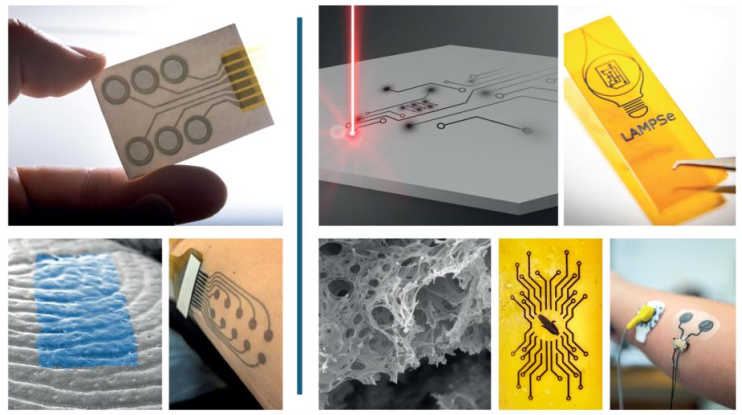
The deposition and patterning of soft conductive materials on thin, conformable substrates is utilized to create nearly invisible skin-contact sensors for health and personal monitoring purposes. In this talk I will introduce and compare two technologies investigated in our LAMPSe group @SSSA: I) printing of conjugated polymers on temporary tattoos and II) direct laser writing of conductive carbon.
Temporary tattoo paper offers a straightforward, cost-effective, and versatile platform for "transferable" electronics. We focus on the fabrication of disposable, ultra-conformable Temporary Tattoo Electrodes (TTE) for surface electrophysiology recordings: EMG, ECG, EEG, EDA. TTEs are manufactured through ink-jet or screen printing of the conjugated polymer PEDOT:PSS. Various array and interconnector configurations are tailored for specific applications in bioengineering & biorobotics, enabling new recordings, impossible
with state of art electrodes.1,2
Laser-Induced Graphene (LIG) is a porous conductive carbon created via laser-induced pyrolysis of polymer precursors like polyimide. This technique allows for rapid, maskless circuit engraving on insulating precursors, fostering advancements in flexible/stretchable/wearable electronics3 and soft robotics.4 By embedding LIG in thin elastomer films (PDMS, medical grade Polyurethane), we developed stretchable connectors, skin-contact electrodes, and soft wearable sensors (physical: temperature, strain/pressure; and electrochemical: analytes in sweat).5,6 We also investigate natural materials (e.g., agricultural and food waste)7 and bioderived polymers8 as sustainable substrates/precursors for LIG-based sensors and green electronics.9 The recent discovery of inks and dyes as optimal precursors for LIG can make the two approaches converge into a single “Print & Scribe” approach and opens the way to new applications.10
1. Ferrari, L. M. et al. Adv. Sci. 5, 1700771 (2018).
2. Ferrari, L. M., et al. Multifunct. Mater. 3, 032003 (2020).
3. Ye, R., et al. Adv. Mater. 31, 1803621 (2019).
4. Bressi et al. Adv. Intell. Systems 240107 (2025).
5. Dallinger, A., et al. ACS Appl. Mater. Interfaces 12, 19855 (2020).
6. Vivaldi, F. et al. APL Bioeng. 6, 036104 (2022).
7. Steksova, Y. et al. Adv Funct. Mater. e07462 (2025).
8. Sankaran, S. T. et al. Small 2405252 (2024).
9. Bressi, A. C., et al. ACS Appl. Mater. Interfaces 15, 35788 (2023).
10. Dallinger, A. et al. Adv. Science 2, 2412167 (2025).
Short Biography
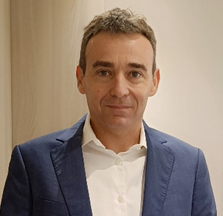
Francesco Greco is an Associate Professor at the Biorobotics Institute of Scuola Superiore Sant’Anna (SSSA), Pisa since 2021 and Head of the Laboratory of Applied Materials for Printed and Soft Electronics.
Formerly, he has been Assistant Professor at Institute of Solid State Physics – TUGraz (Austria), Associate Professor at School of Advanced Science and Engineering, Waseda University, Tokyo (Japan), appointed by the Top Global University Program, Unit for Energy and Nanomaterials, JAPAN. He was a Postdoc and then Researcher (Team Leader) at Center for MicroBiorobotics of Istituto Italiano di Tecnologia (CMBR IIT).
He received a MSc in Materials Science (with honours) in 2004 and Ph.D. in Chemical Sciences in 2009 from the University of Pisa, Italy. His research focuses on functional polymer and composite materials with applications in organic bioelectronics, bioengineering, soft- and bio-robotics, sensors, within 2 main themes: 1) Tattoo Electronics, and 2) Laser Induced Graphene . He has relevant experience as PI in several European, National, Regional and Industry-funded projects and as academic consultant for advanced polymer materials and electromedical devices. He is the (co)author of ~ 85 peer-reviewed full papers, 4 book chapters and coinventor of 8 international patents/patents applications.
website: Laboratory of Applied Materials for Printed and Soft electronics | Scuola Superiore Sant'Anna