
[October 23, 2026] Special Lectures by Visiting Professor, Dr. Gianni Ciofani, "Next-generation bionanotechnology: From functional nanomaterials to human-on-chip platforms," and Dr. Melis Emanet, "Assessment of Microgravity-Induced Alterations in Ovarian Follicles Using an Organ-on-a-Chip System"

- Date & Time
- 9:00 - 10:15, Friday, October 23, 2026
- Venue
- Seminar RM2, 3rd floor, TWIns
- Audience
- Waseda students, researchers and faculties
- Contact
- More info
- 9:00-9:50 Lecture by Dr. Ciofani / 9:50-10:15 Lecture by Dr. Emanet
We are pleased to host Visiting Professor Dr. Gianni Ciofani and his colleague Dr. Melis Emanet, both from the Italian Institute of Technology (IIT), during their visit from late September to early November. They will the following presentations:
- Dr. Gianni Ciofani: 'Next-generation bionanotechnology:From functional nanomaterials to human-on-chip platforms'
- Dr. Melis Emanet: 'Assessment of Microgravity-Induced Alterations in Ovarian Follicles Using an Organ-on-a-Chip System'
All are welcomed to join. Please register here (contact form) if you wish to attend the lecture.
Abstract
Next-generation bionanotechnology: From functional nanomaterials to human-on-chip platforms
Dr. Gianni Ciofani Smart Bio-interfaces, Italian Institute of Technology
What happens when materials are designed to interact with living cells, respond to their environment, and help us understand disease? This talk explores three connected frontiers of bioengineering. First, smart nanomaterials can carry therapeutic agents, influence cellular responses, and open new possibilities for more targeted treatments [1]. Second, organs-on-chip recreate key features of human tissues in miniature, offering ways to study disease and test interventions in settings that better reflect the body [2]. Third, experiments in microgravity reveal how cells and tissues change beyond Earth, providing insights into astronaut health and fundamental biological processes [3, 4]. Drawing on research conducted both in the laboratory and aboard the International Space Station, the talk will show how these approaches can inform one another: advanced tissue models help us investigate the effects of spaceflight, while the challenges of space inspire new tools for medicine on Earth. Together, nanomedicine, organs-on-chip, and space research illustrate how intelligent materials may bring us closer to more precise therapies and a deeper understanding of human health.
References
[1] Curiale T., Lefevre M.C., Carmignani A., Ceccarelli M.C., Battaglini M., Marino A., Ciofani G. Smart nanotechnologies for multimodal neuromodulation and brain interfacing. Advanced Science, 10.1002/advs.202524300
[2] Marino A., Ziaja K., Lefevre M.C., Ceccarelli M.C., Battaglini B., Filippeschi C., Ciofani G. High-throughput impedance monitoring in 3D tumor cultures: A multiplex, microfluidic-free platform for drug screening. Lab on a Chip, 25(22): 5695-6064 (2025)
[3] Carmignani A., Marino A., Battaglini M., Di Leo N., Carrubba E., Balsamo M., Valentini G., Mascetti G., Perilli S., De Boni F., Marras S., Prato M., Genchi G.G., Ciofani G. Neuroprotective effects of cerium oxide nanoparticles during spaceflight. Small Science, 6(4): 70271 (2026)
Gianni Ciofani (born in La Spezia, Italy, on August 14th, 1982), Ph.D., is Senior Researcher Tenured at the Istituto Italiano di Tecnologia -Italian Institute of Technology, IIT- (Pontedera, Italy; since 2019), where he is Principal Investigator of the Smart Bio-Interfaces Research Unit (since 2017) and Coordinator of the Center for Materials Interfaces (since 2021). He has been Associate Professor at the Polytechnic University of Torino (Torino, Italy; 2015-2019), and Visiting Professor at Waseda University (Tokyo, Japan; 2021) and at the Pontifical Catholic University of Rio de Janeiro (Rio de Janeiro, Brazil; 2024).
His main research interests concern smart nanomaterials for nanomedicine, microphysiological systems, and nanomedicine in altered gravity conditions. He is coordinator or unit leader of several projects (about 6.7 MEur granted): in particular, he was awarded a Starting Grant and three Proof-of-Concept Grants by the European Research Council (ERC). Thanks to grants from the Italian Space Agency and the European Space Agency, he had the opportunity to carry out four experimental campaigns onboard the International Space Station. In 2018, his real-scale model of the blood-brain barrier was highlighted in the Annual Report on the ERC Activities and Achievements.
Gianni Ciofani is author of about 220 papers on international journals (WoS H-index 60), 3 edited books, and 20 book chapters, and delivered about 100 invited talks/lectures in international contexts. He has been consistently ranked in the Stanford University’s list of “World’s Top 2% Scientists” since 2020 (Elsevier data).
He serves as Panel Member / Reviewer for many funding agencies (including ERC, Swiss National Science Foundation, French National Research Agency, National Science Center of Poland), for about 200 international journals, and as Editorial Board Member of Biomedical Materials, Bioactive Materials, International Journal of Nanomedicine, Journal of Physics: Materials, Nano Trends, and Scientific Reports; he is Editor-in-Chief of BMC Biomedical Materials Science, Co-Editor-in-Chief of Nanomedicine, and Specialty Chief Editor (Nanobiotechnology) of Frontiers in Bioengineering and Biotechnology. Since 2026, he serves as a Member of the European Space Agency’s Human Spaceflight and Exploration Science Advisory Committee.
During his career, he held courses at the Polytechnic University of Torino, at Waseda University, and at the Pontifical Catholic University of Rio de Janeiro, and is currently holding a course for Ph.D. students at the Sant’Anna School of Advanced Studies (Pisa, Italy); he is / has been supervisor of about 50 M.Sc. students and 25 Ph.D. students.
He is co-founder (2022) and Scientific Advisor of “Kidaria Bioscience SRL”, an IIT spin-off company dedicated to the preparation and characterization of cosmetic and nutraceutical products based on natural-derived active ingredients. He is also co-founder (2021) and member of the executive committee of “ERC in Italy APS”, a non-profit association of ERC awardees born to promote fundamental and frontier research in Italy.
Gianni Ciofani is Knight of the Order of Merit of the Italian Republic, appointed by the President of the Italian Republic (2022), and Corresponding Member of the Ligurian Academy of Sciences and Letters (2025).
Assessment of Microgravity-Induced Alterations in Ovarian Follicles Using an Organ-on-a-Chip System
Dr. Melis Emanet Smart Bio-interfaces, Italian Institute of Technology
Introduction
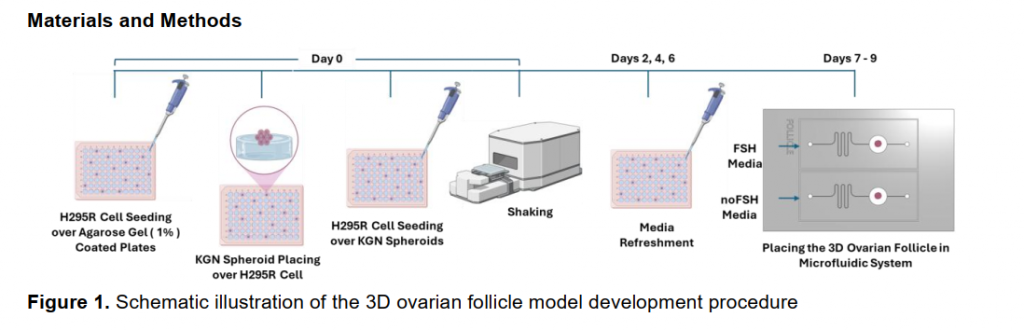
Gravity is a key physical force shaping living systems, from cytoskeletal organization and intracellular transport to cell proliferation, differentiation, polarity, and communication1. Because ovarian follicles rely on tightly coordinated local and endocrine signals, ovarian function is especially vulnerable to physical stressors such as altered gravity2. To assess potential reproductive risks during spaceflight, we investigated the effects of simulated microgravity (S-µG), generated by a random positioning machine, on KGN granulosa spheroids and H295R theca-like cultures, developing 3D human ovarian follicle models. Follicular activity was supported with follicle-stimulating hormone (FSH) and luteinizing hormone (LH). We then examined how S-µG affected
paracrine signaling, cellular stress responses, and cell death compared with earth-gravity controls.
Results
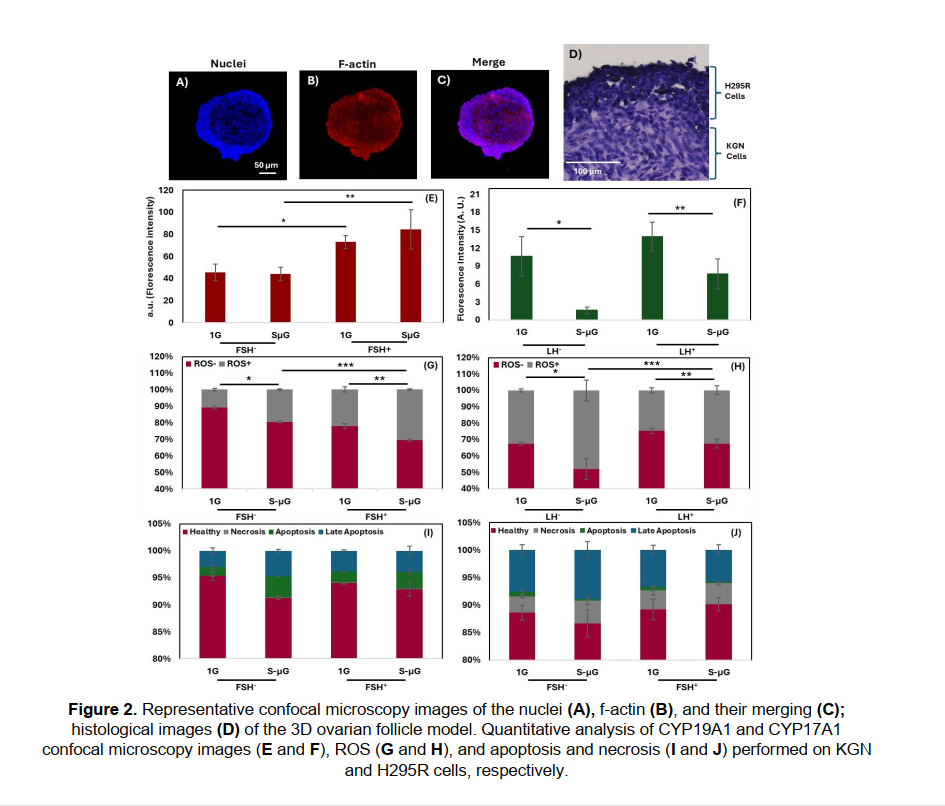
The 3D ovarian follicle model was structurally characterized by confocal microscopy following staining of nucleic acids with Hoechst and F-actin with phalloidin-FITC (Figure 2A-C). The distinct nuclear morphology of KGN and H295R cells enabled rough spatial discrimination within the construct, with KGN cells organized into a central spheroid surrounded by an outer layer of H295R cells. This arrangement was further confirmed by histological
evaluation of sectioned samples stained with hematoxylin and eosin, which supported the confocal observations (Figure 2D). Functional analyses showed that FSH or LH modulated steroidogenic enzyme expression under both earth gravity and S-µG (Figure 2E and F). In KGN cells, FSH treatment significantly increased CYP19A1 expression regardless of gravitational status. In contrast, CYP17A1 expression in H295R cells was significantly reduced under S-µG, although LH treatment partially restored its levels. S-µG also induced a significant ROS production in both cell types (Figures 2G and H), and KGN cells exhibited altered necrosis and late apoptosis under S-µG without FSH treatment (Figures 2I and J).
Conclusion
The 3D ovarian follicle model successfully recapitulated follicular architecture, with KGN spheroids centrally enclosed by H295R cells, as confirmed by confocal and histological analyses. Functionally, gonadotropin signaling partly preserved steroidogenic competence under S-µG: FSH sustained CYP19A1 expression, whereas CYP17A1 declined despite partial LH rescue. S-µG also increased oxidative stress and selectively promoted KGN apoptotic/necrotic vulnerability in this model.
Acknowledgements
This research has received funding from the European Space Agency (4000145476).
References
1H Winkler, L. Human Physiological Limitations to Long-Term Spaceflight and Living in Space, Aerospace Medicine and Human Performance
(2023) 94;444.
2Liu, M. Ultrastructure of isolated mouse ovarian follicles cultured in vitro, Reproductive Biology and Endocrinology (2011) 9;1.